Can Ayurvedic Medicine Have Side Effects?
HappyWaves Team
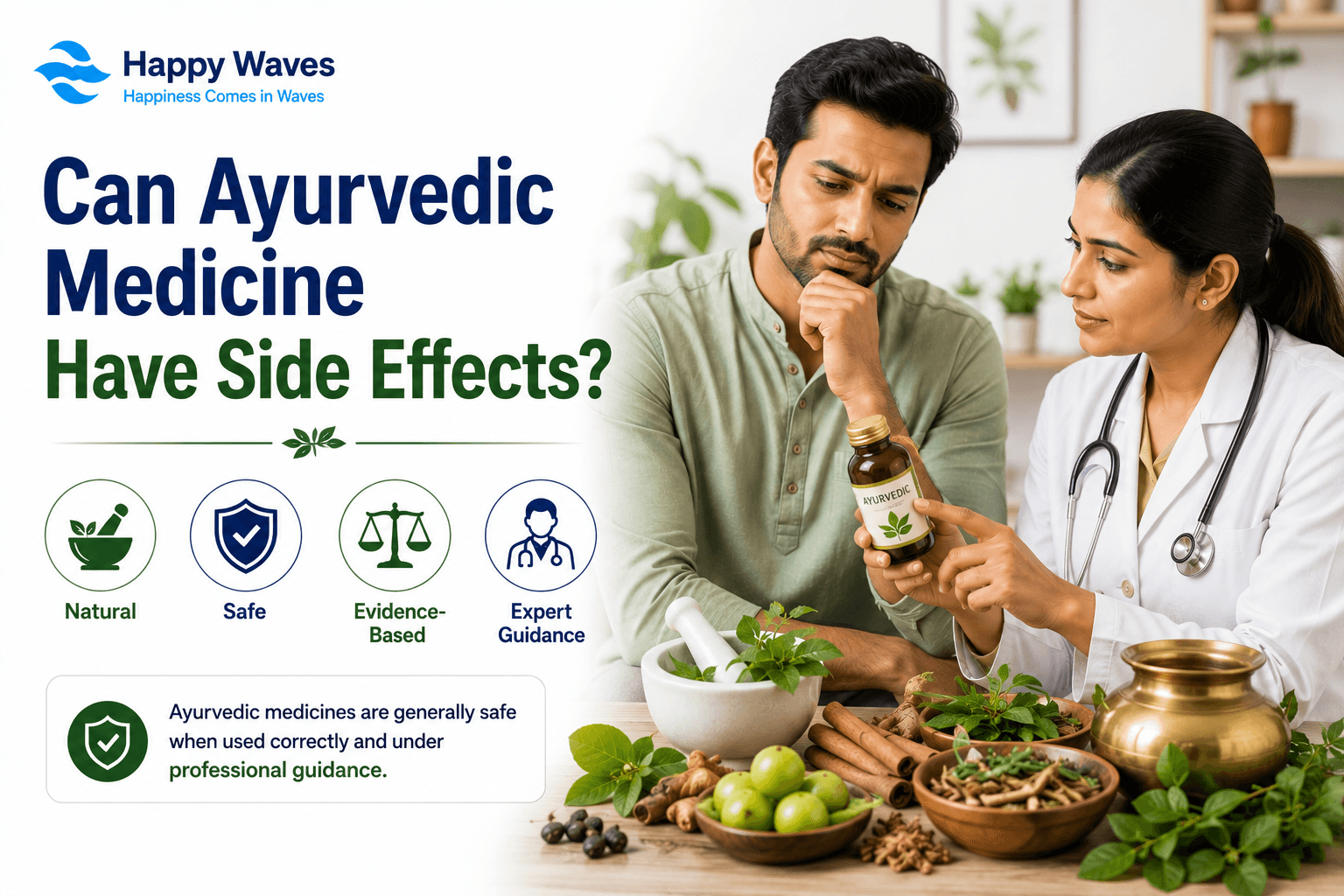
Ayurveda has been practised in India for over 5000 years. Millions of people across the country use Ayurvedic medicines daily for everything from digestive concerns to hormonal health to sexual wellbeing. And for the most part, Ayurvedic treatment, prescribed properly by a qualified practitioner, is remarkably safe.
But "can Ayurvedic medicine have side effects?" is a genuinely important question and it deserves a genuinely honest answer rather than either blind reassurance or unnecessary alarm.
The answer is: yes, Ayurvedic medicine can have side effects but the risk depends enormously on how, what, and from whom you are taking it.
Properly prescribed, high-quality Ayurvedic medicine used under qualified guidance is safe for the vast majority of people. But the unregulated, over-the-counter Ayurvedic supplement market where products are self-selected, unverified, and consumed without professional guidance carries real risks that every patient deserves to understand.
This guide gives you the balanced, research-backed truth so you can use Ayurvedic medicine safely, effectively, and with confidence.
Understanding Ayurvedic Medicine
Before discussing side effects, it helps to understand what Ayurvedic medicine actually uses.
Ayurveda uses a wide range of herbs and plants for medicinal purposes. Ayurvedic texts classify herbs according to their safety and potential toxicity; the "Bhavaprakasha Nighantu" and other Ayurvedic pharmacopeias provide information about the toxicity, dosage, and contraindications of various herbs.
In Ayurveda, medicines generally fall into three categories:
1. Herbal preparations (Kashaya, Churna, Kwath) - Made purely from plant materials: roots, leaves, bark, seeds, and fruits. These form the majority of Ayurvedic medicines and carry the lowest risk profile when sourced and prescribed correctly.
2. Mineral-herbal formulations (Rasa Shastra) - Classical Ayurveda includes preparations that incorporate processed metals and minerals - including gold, silver, mercury, lead, iron, and arsenic in a purified form called Bhasma. These are intentionally detoxified through an elaborate process of purification and incineration described in classical Ayurvedic texts. When prepared correctly by skilled practitioners, they are considered safe and therapeutically potent. When prepared incorrectly or obtained from unverified sources, they represent the most significant risk in Ayurvedic medicine.
3. Dietary and lifestyle guidance - Including specific foods, daily routines, yoga, and breathing practices. These carry essentially zero toxicity risk.
Most Ayurvedic medicines used in everyday sexual health care including Ashwagandha, Shilajit, Shatavari, Gokshura, and Safed Musli fall into the first category and are very well-tolerated when taken appropriately.
Real Side Effects of Ayurvedic Medicine
Let's be clear and honest about the risks that exist without exaggerating them.
1. Heavy Metal Contamination
This is the most significant and most researched risk in Ayurvedic medicine and it comes primarily from two sources: mineral-herbal (Rasa Shastra) formulations, and contamination of herbal products during processing.
Ayurvedic medications have been found to contain high levels of lead as well as other heavy metals, which constitute serious health risks. According to one investigation, lead was identified in 65% of 252 Ayurvedic medicines mixed with mercury. Lead accumulates in the brain, spleen, kidneys, liver, and lungs, as well as in blood, bone, and soft tissues.
Of 70 Ayurvedic products tested in one study, 14 (20 percent) contained heavy metals 13 had lead, six had arsenic and six had mercury. According to researchers, each of these 14 products, if taken as directed, could result in heavy metal intakes above regulatory standards.
This sounds alarming and the risk is real. But important context is needed:
A 2024 Kerala study testing 36 Ayurvedic decoction samples found heavy metals within Ayurvedic Pharmacopoeia of India limits, suggesting heavy metal contamination of Ayurvedic formulations may not be as widespread as suspected though continuous dynamic monitoring of Ayurvedic herbal formulations for heavy metal contamination is warranted.
A ScienceDirect study on nine common Ayurvedic herbal products found that when consumed in the recommended dose, heavy metal levels were within the standard limits set by various agencies and posed minimal health risk in both short and long-term consumption.
The honest summary: Heavy metal contamination is a documented risk in certain Ayurvedic products particularly unregulated OTC mineral-herbal formulations. It is NOT an across-the-board risk of all Ayurvedic medicine, particularly for commonly used sexual health herbs like Ashwagandha and Shatavari. The risk is concentrated in specific product types and unregulated sources.
2. Herb-Drug Interactions
This is a risk that many patients and some doctors don't think about.
Herb-drug interactions represent indirect mechanisms including Ashwagandha-warfarin metabolism interference and Turmeric-metformin absorption effects. Understanding these interactions is essential.
Common herb-drug interactions relevant to sexual health patients include:
-
Ashwagandha - May interact with thyroid medications (can amplify effects), immunosuppressants, and blood pressure medications. Also affects sedatives can increase drowsiness when combined with medications like benzodiazepines
-
Shilajit - May affect iron absorption and interact with blood thinners
-
Turmeric (curcumin) - Can reduce absorption of metformin (diabetes medication) and interact with anticoagulants
-
Gokshura - Can affect blood sugar medications and diuretics
-
Shatavari - May interact with hormonal medications and lithium
Important: These interactions don't make these herbs unsafe, they make them medicines that should be used under proper professional guidance, with full disclosure to your healthcare provider about everything you are taking.
3. Adulteration and Species Substitution
Raw material screenings have shown that 59% of herbs studied possess DNA barcodes from species not on the label, with 68% species substitution occurring. Raw material screenings have also shown contamination of pesticide residues and heavy metals greater than FSSAI permitted limits.
This is a problem not with Ayurvedic medicine itself, but with the unregulated commercial supplement market that uses Ayurvedic vocabulary without Ayurvedic standards. When you buy an "Ashwagandha supplement" from an unverified online source, you may not be getting Ashwagandha or not Ashwagandha alone.
The solution: source medicines through qualified practitioners who use verified, quality-controlled suppliers not from unregulated online marketplaces.
4. Dose-Dependent Toxicity of Individual Herbs
Some Ayurvedic herbs are safe at therapeutic doses but potentially harmful at excessive doses:
-
Liquorice root (Mulethi) - Can raise blood pressure and cause potassium depletion in large doses or with long-term use
-
Guggul - Can cause skin rashes, gastrointestinal upset, and thyroid interaction at high doses
-
Kuchla (Strychnos nux-vomica) - Contains strychnine; therapeutically valuable in purified form but toxic if not properly processed
-
Aconite (Vatsanabha) - Used in classical Ayurveda in very small, highly purified doses; toxic if improperly prepared or dosed
This is precisely why Ayurvedic dosage is not the same as "more is better" , a misconception that drives many self-medication side effects.
5. Inappropriate Use During Pregnancy
Some Ayurvedic herbs are contraindicated during pregnancy. Self-medicating with Ayurvedic products without consulting a qualified practitioner during pregnancy is not safe. Certain herbs can stimulate uterine contractions or affect fetal development.
6. Allergic Reactions
As with any plant-based medicine, allergic reactions to specific Ayurvedic herbs are possible though uncommon. These can range from mild skin reactions to, very rarely, more significant immune responses. Any new rash, itching, or breathing difficulty after starting an Ayurvedic medicine warrants prompt medical attention.
7. Delayed Diagnosis of Serious Conditions
This is perhaps the most underappreciated risk not of the medicine itself, but of using Ayurvedic medicine as a replacement for necessary modern medical diagnosis.
Using Ayurvedic treatment as a substitute for proper assessment of a serious underlying condition whether a cardiac issue underlying erectile dysfunction, an endocrine disorder causing low libido, or a condition requiring surgical intervention delays the diagnosis and treatment that could genuinely protect health and life.
Ayurveda is most safely used alongside, not instead of, appropriate modern medical assessment.
The Majority of Commonly Used Ayurvedic Sexual Health Herbs Are Very Safe
Having laid out the genuine risks, it is equally important to be clear about what the evidence actually shows for the herbs most commonly used in Ayurvedic sexual health care.
The herbs most relevant to sexual health that Happy Waves uses Ashwagandha, Shatavari, Shilajit, Gokshura, Safed Musli, and Kaunch Beej are all plant-derived, have extensive traditional use records spanning centuries, and are increasingly supported by modern clinical research demonstrating both efficacy and safety at recommended doses.
Ashwagandha is one of the most extensively studied Ayurvedic herbs in modern clinical research. Multiple randomised controlled trials have demonstrated safety alongside benefit for stress, testosterone, and sexual health with side effect profiles comparable to placebo at therapeutic doses.
The key factors that make these herbs safe:
-
Using verified, quality-controlled sources
-
Taking them at appropriate doses under professional guidance
-
Disclosing all other medications to your Ayurvedic practitioner
-
Not self-medicating or exceeding recommended doses
-
Having underlying health conditions properly assessed first
How to Use Ayurvedic Medicine Safely
1. Always Consult a Qualified Practitioner
Ayurvedic practitioners must assess a patient's constitution and susceptibility to potential toxicity. Ayurvedic practitioners consider the constitution of an individual (Prakriti) and current imbalance (Vikriti) when prescribing treatments some substances that may be well-tolerated by one person could be harmful to another.
A minimum BAMS (Bachelor of Ayurvedic Medicine and Surgery) qualification is what to look for. If the person prescribing your Ayurvedic medicine cannot provide verifiable credentials that is a warning sign.
2. Disclose Everything to Your Doctor
Tell your Ayurvedic practitioner every medication you are currently taking conventional medications, other supplements, contraceptives, and anything else. Herb-drug interactions are real, and your practitioner cannot protect you from them without full information.
Equally, tell your conventional doctor about any Ayurvedic medicines you are taking particularly if you are managing a chronic condition like diabetes, thyroid disease, or cardiovascular disease.
3. Source From Verified, Quality-Controlled Suppliers
Avoid purchasing Ayurvedic medicines from unverified online marketplaces. Look for products certified by GMP (Good Manufacturing Practice) standards, licensed by the Ayurvedic Pharmacopoeia of India, or prescribed and supplied directly through a qualified practitioner.
4. Never Self-Medicate With Mineral-Herbal Preparations
Classical Ayurvedic formulations containing processed metals and minerals (Bhasmas) should only ever be prescribed by a qualified Ayurvedic physician who can assess their appropriateness for your specific constitution. These should never be self-selected or obtained from unverified commercial sources.
5. Get a Proper Modern Medical Assessment First
Before beginning any Ayurvedic treatment for a sexual health concern erectile dysfunction, premature ejaculation, low libido, vaginismus a proper medical assessment is essential. Understanding the root cause of your concern allows Ayurvedic treatment to be targeted effectively and ensures that any underlying condition requiring modern medical attention is not missed.
6. Report Side Effects
If you experience any unexpected symptoms after starting an Ayurvedic medicine nausea, skin changes, mood shifts, fatigue, or any new physical symptom report this to your practitioner immediately. Do not assume that because it is "natural" it cannot cause side effects.
Ayurvedic Medicine for Sexual Health at Happy Waves
At Happy Waves, we approach Ayurvedic sexual health care with exactly the standards the research supports:
-
All Ayurvedic prescriptions are made by qualified BAMS practitioners
-
Modern medical assessment precedes any Ayurvedic treatment recommendation
-
Herb-drug interactions are checked as a standard part of every consultation
-
Only verified, quality-controlled Ayurvedic formulations are recommended
-
Ayurvedic care is integrated with, not substituted for, appropriate modern sexual health assessment
Whether you are looking for an ayurvedic sexologist near me who genuinely understands both traditions, a sexologist doctor online consultation that incorporates Ayurvedic options safely, sexologist doctors for male near me who can assess whether Ayurvedic treatment is appropriate for your specific sexual health concern, or a sexologist near me for male concerns including ED, PE, or low libido Happy Waves provides this with the proper safety standards that Ayurvedic medicine deserves.
According to Dr. Shaik Safeer Ahmed, a sexologist and holistic wellness specialist at Happy Waves Hyderabad with over 20 years of experience, the most important thing patients can do to use Ayurvedic medicine safely is to consult a qualified practitioner rather than self-selecting OTC products because personalisation is not just the Ayurvedic ideal, it is the actual safety mechanism. The dose, the formulation, and the combination with other treatments all need to be specific to each individual's constitution and health picture.
If you need a sexologist near you in another city, visit Sexologist in Mumbai , Sexologist in Pune, Sexologist in Delhi, Sexologist in Bangalore, Sexologist in Ranchi, Sexologist in Thane, Sexologist in Noida, a compassionate sexologist in Hyderabad, a dedicated sexologist in Kolkata, a qualified sexologist in Chennai,a caring sexologist in Jaipur, sexologist in Surat best sexologist in Bihar or a specialist sexologist in Kanpur , Happy Waves has qualified specialists ready to help you in every city across India and any other city of India you living you can easily approach sexologist near you.
Still reading? The right specialist is one click away. Book your confidential consultation →
Conclusion
Ayurveda is not inherently dangerous. Five thousand years of continuous clinical practice, an increasingly robust body of modern research, and millions of patients who use it safely every day in India all testify to that.
But "natural" does not mean "risk-free" and Ayurvedic medicine, like any medicine, works best when it is prescribed by someone who knows what they are prescribing, to someone whose health picture they genuinely understand, from verified quality-controlled sources, at appropriate doses.
That is exactly the standard Happy Waves upholds for every Ayurvedic sexual health consultation.
Your Next Step
👉 Book a confidential consultation with a Happy Waves ayurvedic sexologist near you
Free Consultation
Concerned about your sexual health?
Speak to a certified sexologist — 100% confidential, no judgement. Same-day slots available.