How Is Sex Determined in Human Beings? Complete Guide
HappyWaves Team
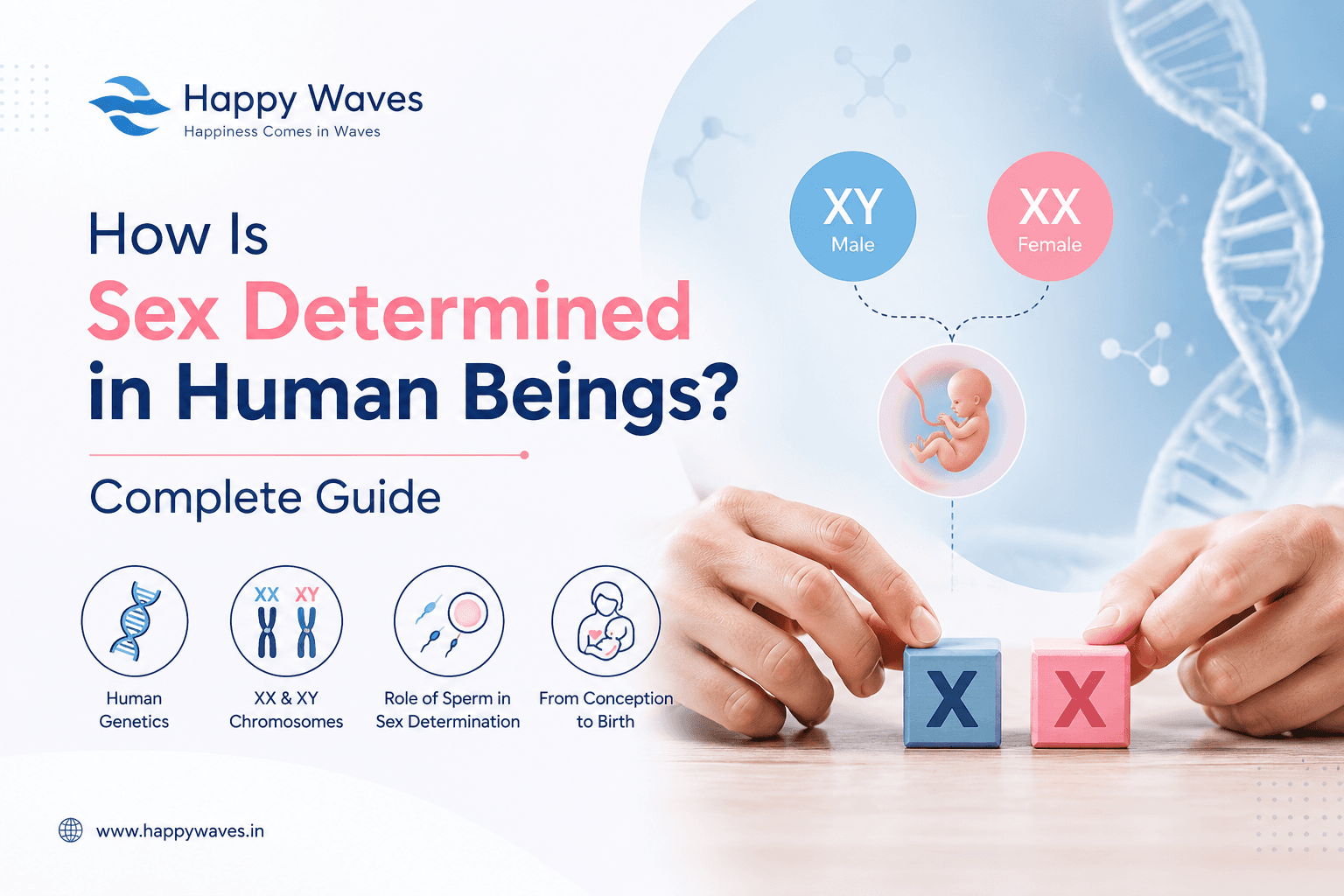
It's one of those questions that sounds simple on the surface but opens into a genuinely fascinating area of human biology. Most of us were taught a basic version in school: girls are XX, boys are XY. And while that's a useful starting point, the full picture of how sex is determined in human beings is far more complex, more interesting, and more relevant to everyday health than most people realise.
Understanding biological sex isn't just academic. It directly shapes how hormones work in your body, how sexual development unfolds from the moment of conception, why certain health conditions affect men and women differently and why some people experience variations in development that fall outside the simple binary model.
This guide explains the complete science of sex determination in human beings from chromosomes and the role of the father's sperm, to the hormonal cascade that shapes development in the womb, to the real-world implications for sexual health.
What Does "Sex Determination" Actually Mean?
Before diving into the mechanisms, it helps to define the term clearly.
Sex determination is the biological process that establishes whether a developing human being will develop as male or female, determining which reproductive organs, hormones, and secondary sexual characteristics will form.
Sex determination is the beginning of the development of many characteristics that influence how a human looks and functions as well as the sexual health and reproductive capabilities that develop throughout a person's life.
The Role of Chromosomes
The foundation of sex determination in humans is the chromosomal sex-determination system specifically, the XY system.
Every human has 23 pairs of chromosomes 46 in total. Of these, 22 pairs are autosomes (non-sex chromosomes), and one pair consists of the sex chromosomes. The sex chromosomes determine an individual's genetic sex. Females typically have two of the same kind of sex chromosome XX while males have two different kinds XY.
Here is how it works step by step:
Step 1 - The Egg and the Sperm
A process called meiosis determines the sex chromosome that the parents' germ cells pass on to their offspring. Meiosis occurs inside the testes and ovaries of the reproductive organs in males and females respectively.
-
Every egg cell (ovum) produced by a woman carries one X chromosome always
-
Every sperm cell produced by a man carries either an X or a Y chromosome in roughly equal proportions
Step 2 - Fertilisation Decides Sex
The sex of an individual is determined at the time of fertilisation. A chromosome from the sperm cell either X or Y fuses with the X chromosome in the egg cell. Depending on which sperm fertilises the egg, the sex of the offspring is determined.
-
X sperm + X egg = XX → typically develops as female
-
Y sperm + X egg = XY → typically develops as male
Females have XX chromosomes and are called homogametic, meaning their gametes carry only one type of sex chromosome. Males have XY chromosomes and are called heterogametic, meaning their gametes can carry either X or Y.
This also answers a question many families quietly wonder about: the father's genetics determine the sex of the child, not the mother's. A woman always contributes an X chromosome; the determining factor is which sperm reaches the egg first.
The SRY Gene - The Master Switch for Male Development
Chromosomes alone don't complete the picture. Within the Y chromosome lives a specific gene that acts as the primary trigger for male sexual development.
The presence of the SRY gene initiates the development of testes, leading to the production of male hormones (androgens) and the development of male reproductive organs. Once the testes are formed, they produce testosterone, which promotes the development of male characteristics.
In the absence of the Y chromosome and SRY gene, the default developmental pathway is female leading to the formation of ovaries and female sexual characteristics.
In simple terms: without the SRY gene switching on male development, the embryo follows a female developmental pathway by default. The Y chromosome specifically SRY actively redirects that process.
The Role of Hormones in Sex Determination and Development
Chromosomes and genes establish the blueprint. Hormones execute it.
A big part of sex and how it develops has to do with chemical hormones such as androgens, oestrogen, and progesterone. All humans have these hormones just in differing quantities and cycles and they fluctuate throughout our lives. A foetus gets the first surge of these hormones in the womb, which triggers things like genital growth and certain types of brain development.
Hormonal Surges That Shape Sexual Development
There are three major hormonal surges across a human lifetime that shape sexual characteristics:
1. In the womb (prenatal) After the SRY gene triggers testis formation in XY embryos, the testes begin producing testosterone. This drives the development of the male reproductive tract. In XX embryos without this testosterone surge, the Müllerian ducts develop into the female reproductive system uterus, fallopian tubes, and upper vagina.
2. Mini-puberty (first six months after birth) Within the first six months of birth, babies have another hormonal surge that endocrinologists call "mini-puberty." This surge plays a role in early reproductive and neurological development.
3. Puberty The most widely recognised hormonal surge where testosterone drives the development of male secondary sexual characteristics (voice deepening, muscle mass, facial hair, sperm production) and oestrogen drives female ones (breast development, menstrual cycle, widening of hips, egg maturation).
These hormonal changes don't just shape physical appearance, they directly influence sexual desire, reproductive function, and emotional wellbeing throughout adult life.
When Sex Determination Is More Complex
The XX/XY model covers the vast majority of humans but biology, as always, is more varied than a simple binary.
While XX and XY chromosomes are often associated with female and male sexes, variations such as XXY, XYY, and others also occur in an estimated 1 in 1,500 to 2,000 people. It is not uncommon for individuals to have atypical combinations of chromosomes, hormones, or anatomy that challenge the binary model of sex assignment.
Common chromosomal variations include:
-
Klinefelter syndrome (XXY) A person with male-typical genitalia but an extra X chromosome; often associated with reduced testosterone production and infertility
-
Turner syndrome (XO) A person with one X chromosome and no second sex chromosome; associated with short stature, ovarian insufficiency, and fertility challenges
-
XYY syndrome An extra Y chromosome; usually presents without obvious physical differences
-
Intersex conditions A broad range of variations where chromosomal, gonadal, or anatomical sex characteristics don't fit typical binary definitions
Conditions like Klinefelter syndrome are directly associated with erectile dysfunction, low testosterone, and fertility concerns and many men don't discover the chromosomal basis of their symptoms until they consult a specialist.
Why Sex Chromosomes Matter for Diagnosis
Chromosomal variations even when mild or previously undiagnosed can explain sexual health concerns that don't respond to standard treatments.
A man experiencing erectile dysfunction, low libido, and infertility who has never had a chromosomal assessment may be living with undiagnosed Klinefelter syndrome (XXY). A woman experiencing primary infertility with no periods may be living with undiagnosed Turner syndrome (XO).
These are not rare edge cases. Chromosomal variations occur in an estimated 1 in 1,500 to 2,000 people which translates to hundreds of thousands of people in India alone who may be carrying an undiagnosed chromosomal variation that is directly contributing to their sexual or reproductive health concerns.
At Happy Waves, our sexologists take this comprehensive approach to every consultation. Book a complete sexual health assessment →
The Development Timeline
Here is a clear summary of how sex determination unfolds from conception through puberty:
|
Stage |
What Happens |
|
Fertilisation |
Sex chromosomes (XX or XY) established at the moment sperm meets egg |
|
Week 6 of gestation |
First visible signs of gonadal differentiation testes or ovaries begin forming |
|
Weeks 8–12 |
SRY gene triggers testosterone production in XY embryos; male reproductive tract develops |
|
Weeks 9–15 |
External genitalia differentiate male or female appearance develops |
|
Birth – 6 months |
"Mini-puberty" hormonal surge; further early reproductive development |
|
Puberty (9–16 years) |
Secondary sexual characteristics develop fully under hormonal influence |
|
Adulthood |
Hormones continue to govern sexual function, desire, and reproductive capacity |
Common Myths About Sex Determination in Humans
Myth 1 - "The mother determines the baby's sex"
Fact: The mother always contributes an X chromosome. It is the father's sperm carrying either X or Y that determines the sex of the child. This has been scientifically established and confirmed.
Myth 2 - "Sex is determined weeks after fertilisation"
Fact: Sex is determined in human beings at the time of fertilisation the sex of the baby depends upon the sperm which fertilises the ovum. The chromosomal sex is established instantly at fertilisation. What takes weeks is the expression of that sex through physical development.
Myth 3 - "It's purely about chromosomes - XX is always female, XY is always male"
Fact: While chromosomes are the foundation, sex development also depends on the SRY gene, hormonal exposure during development, and receptor sensitivity. Someone's chromosomes might be XY but that person doesn't have a penis, or someone might have XX chromosomes but develop with male-typical genitalia. Biology is more nuanced than a simple binary.
Myth 4 - "Sexual health problems have nothing to do with genetics or biology"
Fact: Many sexual health conditions have direct biological roots including chromosomal variations, hormonal imbalances, and genetic factors affecting testosterone receptors or serotonin pathways. Understanding biology is an essential part of accurate diagnosis and effective treatment.
Our sexologists at Happy Waves combine biological assessment (hormonal panels, medical history, investigation guidance) with psychological evaluation and relationship context providing the complete picture that leads to the most effective treatment.
Whether you're in Delhi, Mumbai, Bangalore, Hyderabad, Kolkata, Chennai, Pune, Jaipur, Kanpur, or anywhere across India Happy Waves brings expert, confidential sexual health care directly to you in-clinic or online.
Book a confidential sexual health consultation at happywaves.in →
Free Consultation
Concerned about your sexual health?
Speak to a certified sexologist — 100% confidential, no judgement. Same-day slots available.