Who Invented Sex? The History of Human Sexuality Explained
HappyWaves Team
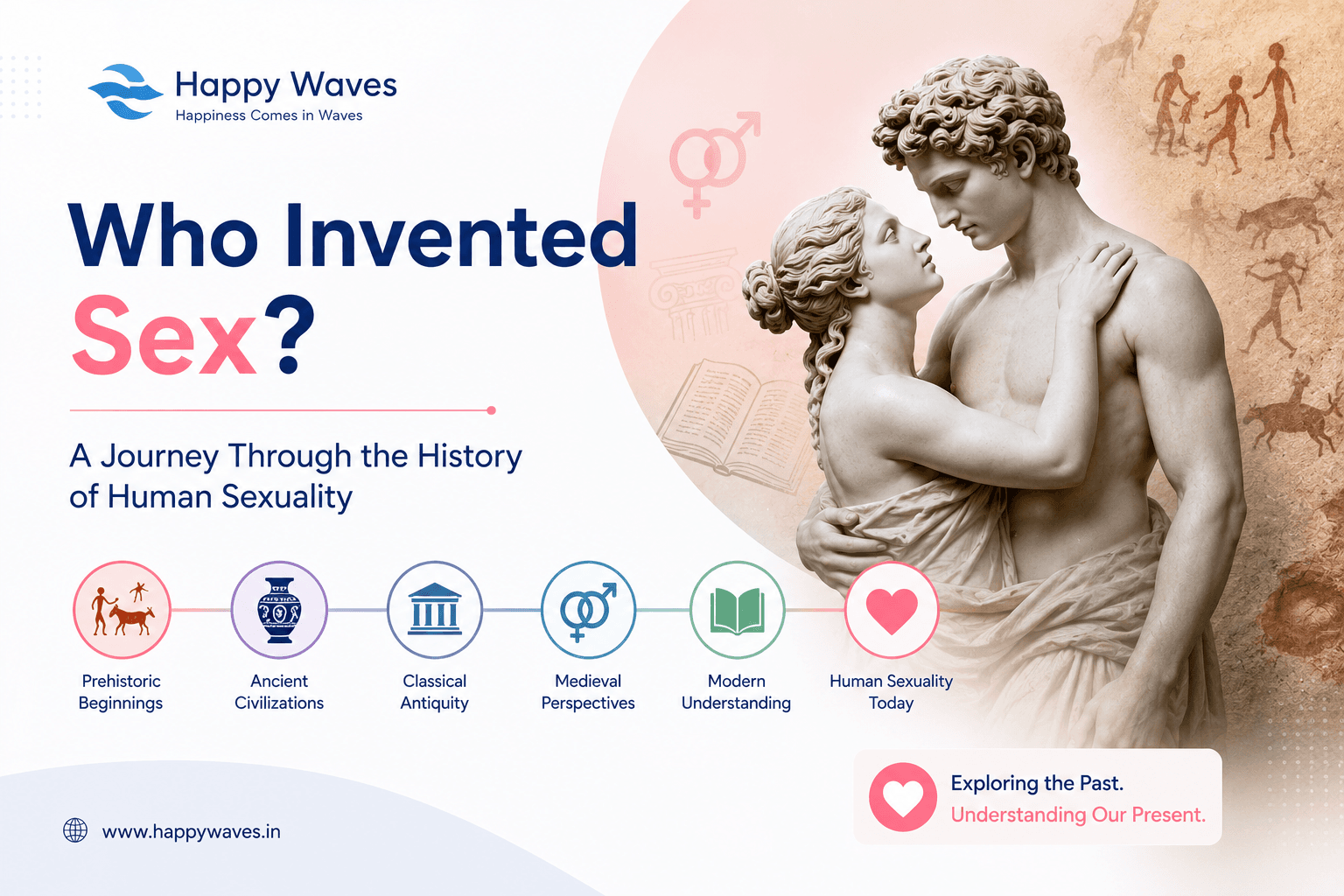
Nobody "invented" sex. Sexual behaviour is as old as the human species itself older, in fact. It predates language, writing, civilization, and every cultural tradition on earth. It is a biological reality that has existed for hundreds of millions of years across virtually every form of animal life on the planet.
But here is what makes the question genuinely interesting: while sex as a biological act was never invented, the way human beings have understood, discussed, celebrated, and sought to improve their sexual lives has a rich, fascinating, and surprisingly relevant history.
From the temples of ancient India to the clinics of modern sexual medicine from the Kamasutra to the work of Masters and Johnson the human relationship with sexuality has been studied, debated, written about, and refined across thousands of years. And India, remarkably, played a central role in that history.
Did Anyone "Invent" Sex?
Sex as a biological reproductive mechanism evolved approximately 1.2 billion years ago in early eukaryotic organisms. It was not invented by any person, culture, or civilization. It is a fundamental feature of complex life on earth, encoded in the biology of virtually every animal species that has ever existed, including human beings.
What humans have invented over thousands of years is the framework for understanding, discussing, and caring for sexual health. And that history is genuinely remarkable.
Ancient India and the Kamasutra
If any single civilisation can claim to have most systematically studied and documented human sexuality as a science, it is ancient India.
The Kamasutra is classified as a shastra, a genre of texts that aspire to explain everything in a scientific way about their subjects. The erotic science, known as kama-shastra, is one of the three principal human sciences in ancient India.
The Kamasutra is believed to have been written between approximately 320 and 550 CE during India's Gupta Golden Age by a religious student and philosopher named Vatsyayana. The title translates roughly to "The Aphorism of Desire." Most people know it as a guide to sexual positions but this couldn't be further from the truth. Only about 20% of the book's one chapter deals with sexual positions.
What the rest of the Kamasutra covers is genuinely ahead of its time:
-
The psychology of desire and attraction
-
Emotional connection and communication between partners
-
The importance of mutual pleasure not just male satisfaction
-
Courtship, marriage, and relationship dynamics
-
Sexual health and wellbeing as part of overall human flourishing
In India, Hinduism accepted an open attitude towards sex as an art, science, and spiritual practice. The most famous pieces of Indian literature on sex the Kamasutra and Kamashastra, cover most aspects of human courtship and sexual intercourse. The Kamasutra was put together by Vatsyayana from a 150-chapter manuscript that had itself been distilled from 300 chapters, which in turn came from a compilation of some 100,000 chapters of text.
This was not a fringe document. It was a serious, scholarly work on human sexual health produced in a civilisation that understood sexuality as a legitimate and important area of human knowledge.
The sexually explicit carvings at Khajuraho dating to the 10th–11th centuries CE reflect the same philosophy. Sexuality was not shameful in ancient Indian culture. It was sacred, celebrated, and studied.
The contrast with modern India's silence around sexual health could not be more stark or more ironic.
Ancient Egypt - Sex, Religion, and Healing
Ancient Egypt provides some of the earliest recorded evidence of human beings thinking seriously about sexual health as a medical matter.
Egyptian medical papyri, some dating back to 1900 BCE contain references to sexual health concerns, contraceptive methods, and treatments for conditions affecting sexual function. In Egyptian religious tradition, sexuality was deeply intertwined with concepts of creation, fertility, and divine power.
What makes Egypt significant in the history of sexual health is this: the Egyptians were among the first to treat sexual concerns as medical problems requiring professional attention not moral failures requiring punishment. That framing sexuality as health rather than sin is the foundation of modern sexual medicine.
Ancient Greece - The Beginning of Sexual Medicine
Ancient Greece contributed substantially to the early medical understanding of sexual health.
Greek physicians including Hippocrates, widely considered the father of medicine wrote about sexual function, reproductive health, and the physical and psychological factors that affected them. The Greeks understood that sexual difficulties were often connected to broader health conditions, emotional states, and lifestyle factors.
This holistic understanding that sexual health connects to physical health, mental health, and relationship wellbeing is precisely the approach that modern sexologists like those at Happy Waves take today.
Greek philosophers also wrote extensively about the psychology of desire, love, and attraction laying early intellectual groundwork for what would eventually become sex therapy and relationship counselling.
The Islamic Golden Age - Sexual Medicine as a Medical Discipline
Between the 8th and 13th centuries CE, Islamic scholars made significant contributions to sexual medicine as part of a broader revolution in medical science.
Physicians like Ibn Sina (Avicenna) whose Canon of Medicine remained a standard medical text in Europe until the 17th century wrote detailed sections on sexual health, including treatments for erectile dysfunction, low desire, and reproductive concerns.
What is remarkable about this period is the professionalism and clinical rigour brought to sexual health. Ibn Sina treated sexual concerns as legitimate medical problems with identifiable causes and evidence-based treatments not moral failings or spiritual punishments.
This medical tradition directly influenced European medicine and laid important groundwork for the development of modern sexual medicine.
The Victorian Era - When Sexual Health Went Underground
The 19th century represents, in many ways, the low point in the history of sexual health understanding.
Victorian moral culture which influenced both Europe and colonial India deeply classified virtually all sexual discussion as improper. Sexual concerns became shameful secrets rather than medical problems. Masturbation was condemned as causing illness. Women's sexual desires were denied entirely. Men suffering from sexual dysfunction had nowhere to turn.
The consequences of this cultural repression were significant and lasting. Much of the stigma that prevents people across India from seeking sexual health help today has roots in Victorian-era moral frameworks that were imported during British colonial rule overlaid onto a culture that had, centuries earlier, produced the Kamasutra.
The irony is profound: India went from producing the world's most comprehensive guide to sexual health as a science, to inheriting the most sexually repressive cultural framework of the modern era.
The 20th Century - Modern Sexual Medicine Is Born
The scientific revolution in sexual health began in earnest in the 20th century and it permanently changed how sexual concerns are understood and treated.
Alfred Kinsey (1940s–50s) conducted the first large-scale scientific surveys of human sexual behaviour establishing that sexual concerns were far more common than anyone had acknowledged, and that the "normal" range of human sexuality was far wider than Victorian culture had claimed.
William Masters and Virginia Johnson (1960s–70s) transformed sexual health care through their landmark clinical research. They developed what became known as sensate focus therapy, a structured, evidence-based approach to treating sexual dysfunction that remains one of the most effective methods in sexual medicine today. Read our complete guide to sensate focus therapy →
Masters and Johnson's work established several foundational principles that every modern sexologist builds on:
-
Sexual dysfunction has identifiable physical and psychological causes
-
Both partners in a relationship are affected by sexual concerns treatment should involve both
-
Performance anxiety is one of the primary drivers of sexual dysfunction
-
Removing performance pressure through structured, graduated exercises allows natural sexual response to return
-
Sex therapy is a legitimate, evidence-based medical discipline
Helen Singer Kaplan (1970s–80s) further developed the field by integrating psychodynamic psychology into sex therapy recognising that emotional history, past trauma, and unconscious beliefs all shape sexual function and response.
These three researchers, more than anyone else in the 20th century, transformed the treatment of sexual health concerns from guesswork and shame into a genuine clinical science.
The History of Sexology in India
India's contribution to the history of human sexuality is ancient and profound. What is happening now slowly, steadily is the reconnection of India's modern sexual health care with that ancient tradition of treating sexuality as a legitimate area of knowledge and care.
Modern Indian sexual health specialists are reclaiming that tradition building evidence-based, compassionate, culturally informed sexual health care for a population that has been underserved for generations.
According to Dr. Chandra Shekar, a psychiatrist and sexual wellness specialist with over 32 years of experience at Happy Waves, the most important shift happening in India's sexual health landscape is the recognition that sexual concerns are medical concerns deserving the same professional attention, clinical rigour, and freedom from shame as any other area of health. His work embodies exactly the tradition of treating sexual health as a science that India pioneered thousands of years ago.
Modern Sexual Health Care at Happy Waves
The sexual health concerns that bring people to Happy Waves today are the same concerns that human beings have sought help with across millennia: erectile dysfunction, premature ejaculation, painful intercourse, low desire, relationship difficulties, performance anxiety.
What has changed is the quality of the tools available to address them.
At Happy Waves, our sexologists combine the best of modern sexual medicine, evidence-based therapy, accurate diagnosis, integrated physical and psychological care with a deep understanding of India's own rich tradition of treating sexual health as a legitimate and important science.
If you're dealing with erectile dysfunction, premature ejaculation, vaginismus, delayed ejaculation, relationship concerns, or any other sexual health matter you are not alone, you are not broken, and you are standing in a very long tradition of human beings who sought and found expert help.
Our specialists are available across India in Delhi, Mumbai, Bangalore, Hyderabad, Kolkata, Chennai, Pune, Lucknow, Jaipur, Kanpur, and more plus online consultations from anywhere in the country.
Book a confidential consultation at happywaves.in →
Free Consultation
Concerned about your sexual health?
Speak to a certified sexologist — 100% confidential, no judgement. Same-day slots available.